..
Commit & Reveal
Legal aspects of writings are hard. What if we could made a proof of writing a story by adding it to the chain, like Ethereum? [Commitment scheme](https://en.wikipedia.org/wiki/Commitment_scheme) could help us in making this happen. To make it work, whenever a story if finished, I'll:
- calculate it's hash using
Sha256 - add it to the storynomial.eth as a
TEXTrecord - the record will use name of
net.storynomial.stories.STORY-TITLEand the value of the Sha256 - after some time of committing the story will be published
In case of a dispute who published what and when, the proof is on the chain.
This page calculates all the hashes on the client side and attaches them to the story names. It uses the script underneath:
  const text = story.innerText.trim();
  const hash = await crypto.subtle.digest("SHA-256", new TextEncoder().encode(text));
  const hex = bufferToHex(hash);
If a story is updated, I'll keep the original to prove the ownership.
Between the lines
--- title: Between the lines author: https://storynomial.net id: between-the-lines --- 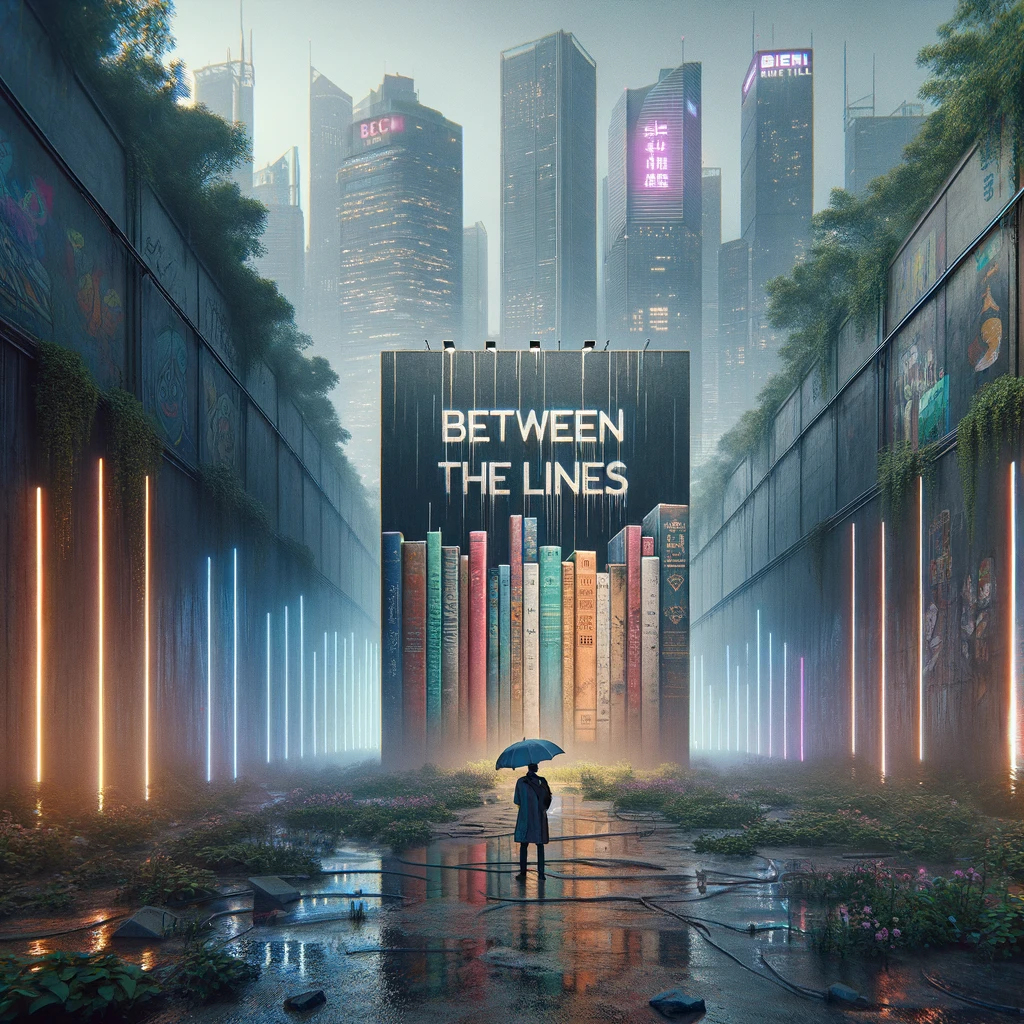 ### The Walk In the heart of a bustling metropolis, nestled between glass skyscrapers and neon billboards, lies a small oasis of tranquility: the biodigital park. Dr. Adrian Hart, an editor renowned for his meticulous work in scientific publishing, finds solace here. The park, a harmonious blend of natural flora and advanced technology, offers a respite from his demanding career. As Adrian wanders along the winding paths, his eyes are drawn to the vibrant murals that adorn the park's walls. One such piece captures his attention—a tapestry of books and tablets, each brimming with painted words in various fonts and sizes. It's a celebration of knowledge, an artist's homage to the written word. However, what truly fascinates Adrian is the playful addition to this mural. Between the lines of text on a digital tablet, someone has whimsically written "Between the Lines." This small act of creativity, finding space where none seems to exist, makes Adrian smile. ### Editorial Back in the familiar confines of his home office, Adrian settles into his daily rhythm. His desk is a chaotic landscape of academic papers and digital screens, each displaying the intricate details of the latest scientific manuscripts. His focus today: groundbreaking research in secure multi-party computation. The routine is comforting in its predictability: sipping coffee, stretching on the yoga mat, then delving into the complex world of editing. The image of the graffiti from his morning walk stays with him, an amusing contrast to the precision of his work. On a whim, Adrian decides to share this amusing contrast with a colleague. He picks up his phone and dials Marina, a fellow editor and a friend who has weathered many intellectual storms with him. "Hey Marina, you won't believe what I saw today", he starts, the laughter evident in his voice. He describes the ironic placement of the writing between the lines. Marina's laughter bursts through the phone, a clear, ringing sound that always brings a smile to Adrian's face. She follows with "It's like a literal interpretation of our daily grind. We're always digging between the lines, aren't we?" Their conversation flows effortlessly, a familiar dance of humor and shared experiences. But it's abruptly cut short when Marina glances at the time. "Oh shoot, Adrian, I've got to run. I need to pick up Ellie from kindergarten. Let's catch up later, okay?" Adrian is left holding the phone, a mix of amusement and sudden disorientation washing over him. He had expected one of their usual hour-long discussions, a deep dive into the absurdities and nuances of their profession. Instead, he's left with a brief, interrupted exchange and an odd, tingling sensation on his skin. He's felt this before, a precursor to something significant, a harbinger of change. Or maybe it's just the unexpected end to a conversation, leaving more unsaid than said. He shakes his head, trying to dispel the strange feeling, but it clings to him, an intangible whisper of something yet to unfold. ### The Sleep That night, Adrian's sleep is restless. He finds himself in a surreal dreamscape, where he is pursued by a relentless stream of text. The words, like sentient beings, twist and turn around him, forming a labyrinth of sentences from which there seems to be no escape. The dream feels oppressively real: every word a whisper, every sentence a shout, echoing the cacophony of his daily life. Waking up in a cold sweat, Adrian feels an overwhelming sense of unease. The dream's vivid imagery lingers, blurring the lines between his subconscious fears and his waking reality. Compulsively, he rises from his bed and makes his way to his computer. The once-familiar screens now seem to hold a deeper mystery, as if beckoning him to look closer, to delve beyond the surface. ### The Comparison 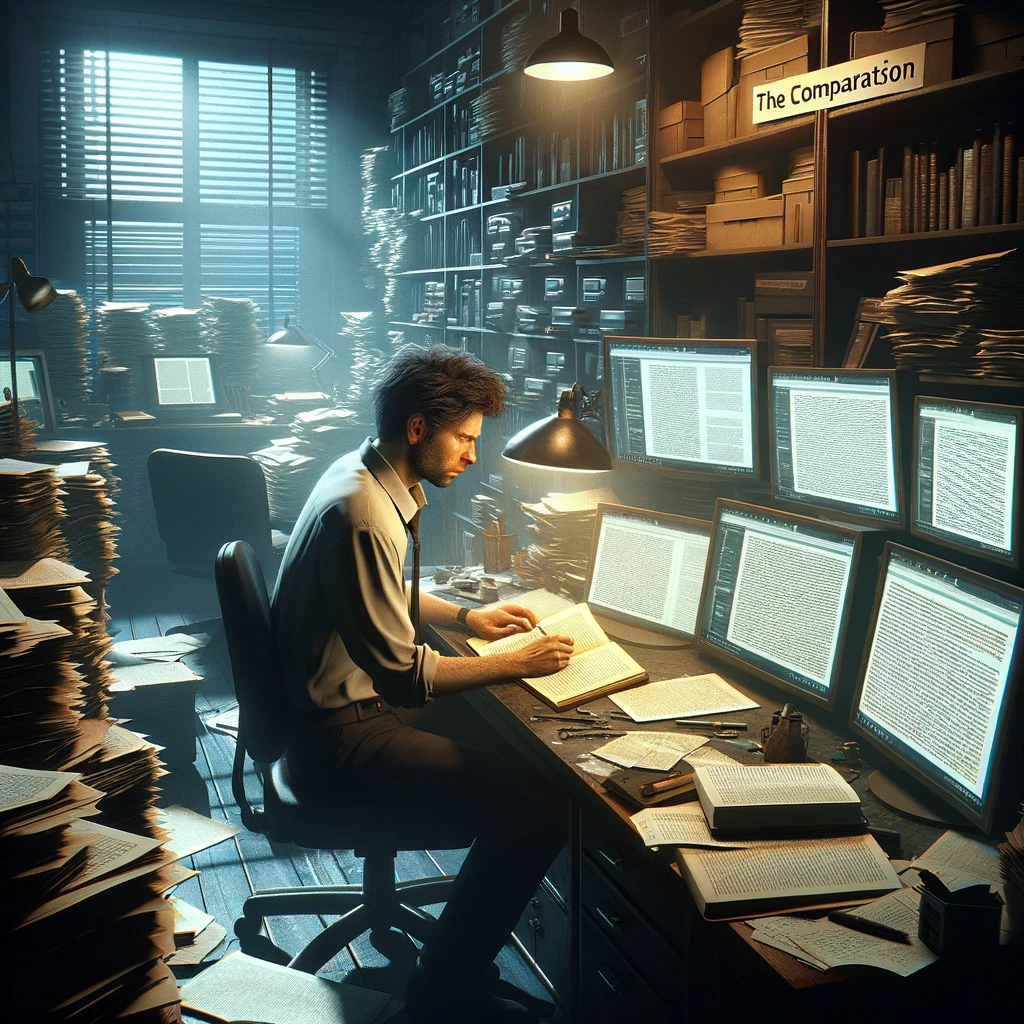 The first light of dawn creeps through the blinds, casting a pale glow across Adrian Hart's cluttered office. He sits hunched over his desk, his eyes bloodshot and fixated on the screen before him. Around him, the room is in disarray: papers scattered, books open to random pages, and his once-organized notes now a chaotic jumble. Adrian's routine has unraveled. The yoga mat, once a symbol of his disciplined morning ritual, lies forgotten in the corner, gathering dust. His once meticulous approach to editing has transformed into an all-consuming obsession. He pores over manuscripts with an intensity bordering on mania, driven by an unshakable conviction that he's on the verge of uncovering something monumental. He no longer works; he excavates. Each line of text is a vein of potential knowledge, each edited paragraph a hidden clue. He's stopped thinking about the end goal, the big discovery that might come from this. All that matters now is the process—the relentless, consuming search for what lies between the lines. The phone rings intermittently, ignored and forgotten. Friends, colleagues, even Marina, have tried reaching out, concerned by his sudden withdrawal. But Adrian is too deep in his quest, too entrenched in the labyrinth of text and theory. His eyes dart back and forth as he compares original drafts to their edited counterparts. The differences are sometimes subtle, sometimes stark. A phrase here, a paragraph there—trimmed, refined, or entirely removed in the pursuit of academic clarity. But Adrian sees them as pieces of a larger puzzle, fragments of ideas and thoughts cast aside in the editing process. Hours turn into days, and Adrian's world narrows to the confines of his office. Coffee cups pile up, untouched meals sit at his side. He's lost track of time, his sense of reality blurred by the relentless pursuit of the unknown. The obsession has taken hold, and there's no turning back. He's compelled to keep digging, keep searching, convinced that within the discarded lies a treasure trove of unacknowledged wisdom, waiting to be discovered. ### The Breakthrough Weeks pass in a blur of relentless analysis and exploration. Then, one evening, as the sun sets in a brilliant display of oranges and purples, Adrian experiences a moment of epiphany. The discarded fragments, the overlooked ideas, they begin to coalesce into a coherent whole. Theories that had been deemed too radical, insights too speculative, suddenly find their place in a grand tapestry of unknowledge. Excited and somewhat incredulous, Adrian reaches out to his network of colleagues and fellow editors. He presents his findings with a cautious optimism, fully aware of their unconventional nature. The responses vary: some express skepticism, others are intrigued. Encouraged, he expands his research, gathering more data, more evidence of the treasure trove of knowledge hidden in plain sight. ### The Book 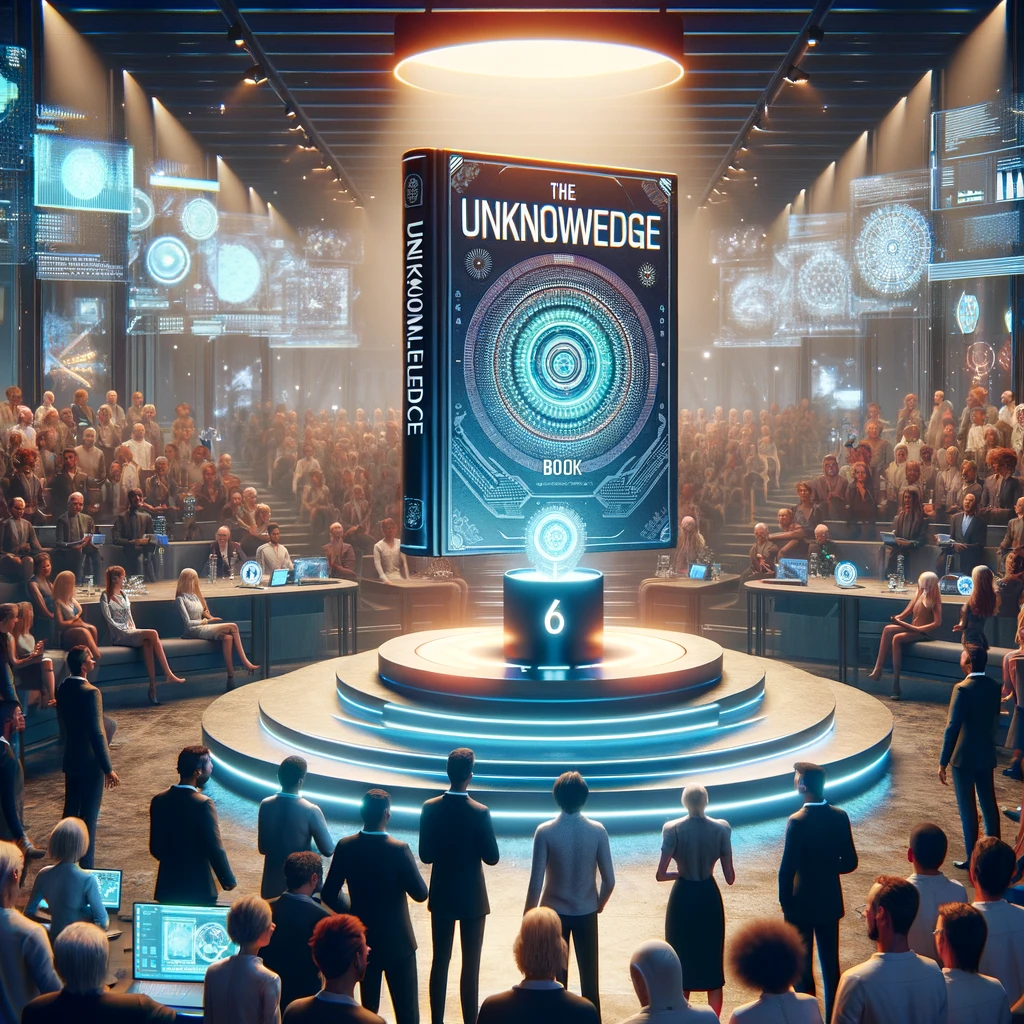 Months later, "The Unknowledge Book" is published. It's a compilation unlike any other, drawing from the margins and footnotes of academic discourse. The book launch is a sophisticated affair, attended by academics and intellectuals, all curious about this new perspective on knowledge. Adrian, now more a discoverer than an editor, finds himself at the center of attention, signing copies and engaging in animated discussions. Amidst the buzz, a keen-eyed reader approaches him. "Who edited this book?" she asks, her voice tinged with curiosity. Adrian names Marina, who had played a crucial role in shaping the final manuscript. The reader smiles knowingly and poses one more question: "Fascinating work. But tell me, what did they leave out in this book?"
Aleph
--- title: Aleph author: https://storynomial.net id: aleph --- 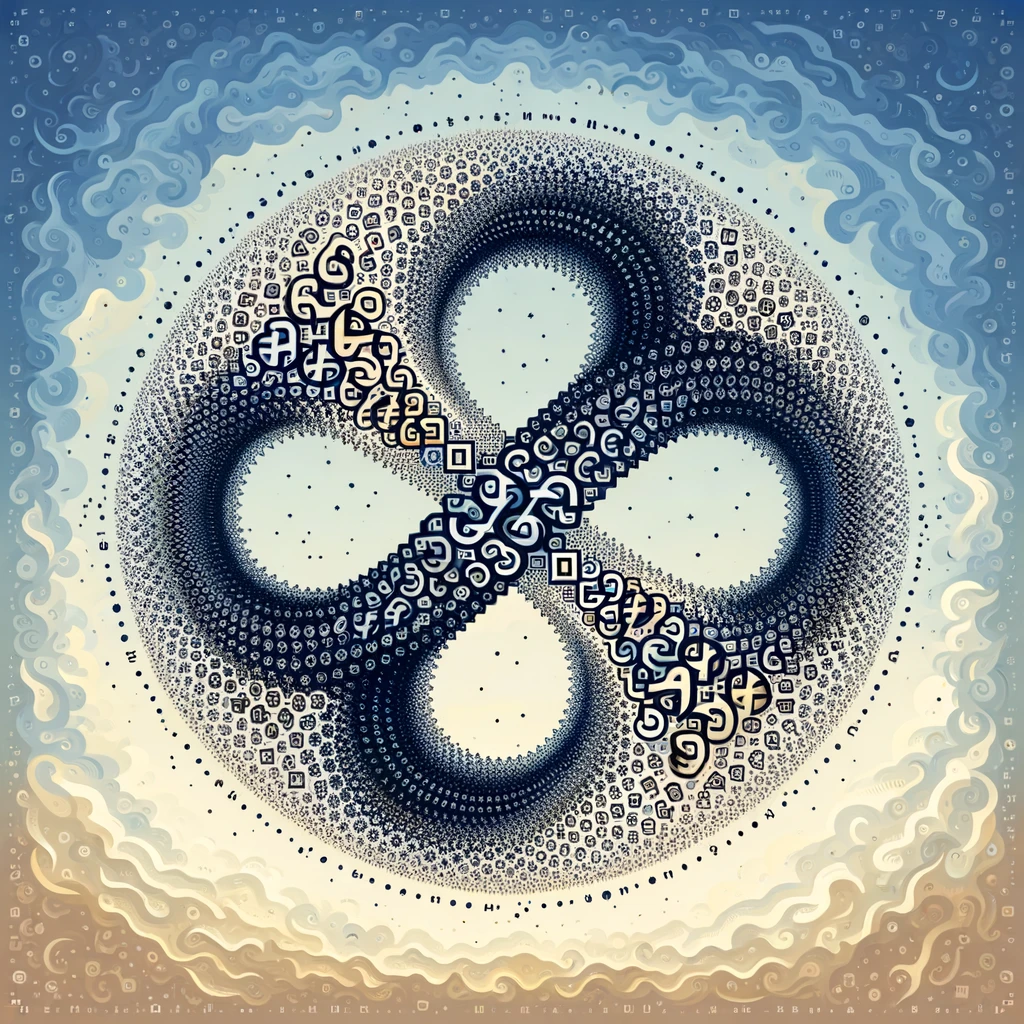 In the Institute of Advanced Computation, a charged silence enveloped the room, illuminated only by the soft luminescence of computer screens. Dr. Ana Ruiz, her eyes reflecting a blend of resolve and wonder, addressed the gathered scientists. "We've just learned what the next thing that we will get from The Generator", she announced. "The output has been verified several times, and yet, it looks unbelievable." --- The journey of The Generator, also known as Aleph, had its roots in 2030, stemming from Dr. Ruiz's accidental discovery. Engaged in a project dubbed Moon Math, she stumbled upon a curious mathematical function, initially dismissed as a mere byproduct of her research. Its significance only came to light when an intern, driven by curiosity, allocated some computational resources to explore it further. The Generator, marked by its recursive complexity, demanded the computation of all previous values to derive each new one. Despite optimization efforts, the process remained arduous, with the outputs revealing layers of mathematical concepts, some echoing known theories and others suggesting uncharted territories. The project soon consumed Dr. Ruiz and her team as they delved deeper into The Generator's labyrinthine calculations. Each new revelation required increasingly more processing power, turning their quest into a race against technological and computational constraints. As the project with The Generator, initially known as Aleph, progressed, the team encountered an unexpected and insurmountable hurdle. The complexity of the computations increased exponentially, culminating in a focus on the intricate world of Riemann mathematics. Despite the team's best efforts to enhance its computational power, the machine, overwhelmed by the advanced mathematical concepts, eventually reached a point of stagnation. The Generator, once a beacon of hope and discovery, fell silent, its last computations lingering on the cusp of solving one of mathematics' most profound riddles. In the wake of this setback, Dr. Ruiz and her team, undeterred, embarked on a quest for a solution. It was during this period of intense research and exploration that they stumbled upon a second, more advanced function buried deep within the original algorithms of The Generator. The new function possessed a more robust and intricate design, capable of handling the complexities that had halted its predecessor. With renewed vigor and excitement, the team set to work on this new version of The Generator, hopeful that it would unlock the mysteries that had remained just out of reach, including the elusive secrets of Riemann mathematics. In the midst of their rigorous exploration, the team stumbled upon a secondary function within the complex framework of The Generator, which they named The Descriptor. Unlike its parent function, The Descriptor was unique in its ability to provide concise, albeit cryptic, summaries of The Generator's intricate outputs. Amidst the dense and often obscure calculations, The Descriptor shone like a beacon, offering glimpses of clarity and insight that were invaluable to the researchers. As the computational demands of The Generator escalated, the project's resources began to dwindle. It was here that The Descriptor played a crucial role beyond its scientific utility. The team leveraged The Descriptor's predictions to secure additional funding and support. By revealing tantalizing hints of what lay ahead in The Generator's outputs, The Descriptor stirred the imagination and interest of both the scientific community and funding bodies. Its abstracts, though brief, were rich in promise, suggesting breakthroughs and revelations that could reshape the mathematics and, potentially, reveal the next steps to move on. With each Description followed by a Generation, it was getting closer and closer to the modern day. --- Dr. Ruiz gazed at the assembled scientists, the weight of their discovery hanging in the air. "We've just learned what the next thing that we will get from The Generator," she announced. "The output has been verified several times, and yet, it looks unbelievable. The description, that The Descriptor gave, is GOD."